
home > books by FWB > 1920, A Bunch of Everlastings > Oliver Cromwell’s Text
VIII
OLIVER CROMWELL’S TEXT
I
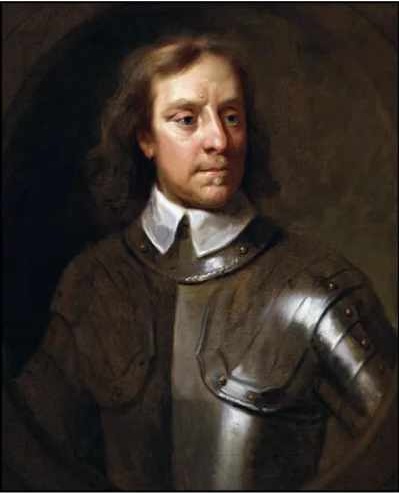 Oliver Cromwell ranks among the giants. Mr. Frederic Harrison sets his name among the four greatest that our nation has produced. Carlyle’s guffaw upon hearing this pretty piece of patronage would have sounded like a thunderclap! Four, indeed! Carlyle would say that the other three would look like a trio of travelling dwarfs grouped about a colossus when they found themselves in the company of Oliver Cromwell. Carlyle can see nothing in our history, nor in any other, more impressive than the spectacle of this young farmer leaving his fields in Huntingdonshire, putting his plough in the shed, and setting out for London to hurl the king from his throne, to dismiss the Parliament, and to reconstitute the country on a new and better basis. He was the one Strong Man; so much stronger than all other men that he bent them to his will and dominated the entire situation. Cromwell made history wholesale. How? That is the question — How? And what if, in our search for an answer to that pertinent question, we discover that it was by means of a text? Let us go into the matter.
II
My suspicions in this direction were first aroused by reading a letter that Cromwell wrote to his cousin, Mrs. St. John, before his public career had begun. In this letter he refers to himself as ‘a poor creature.’ ‘I am sure,’ he says, ‘that I shall never earn the least mite.’ Here is strange language for a man who, confident of his resistless strength, will soon be overturning thrones and tossing crowns and kingdoms hither and thither at his pleasure! Is there nothing else in the letter that may help us to elucidate the mystery? There is! He goes on to tell his cousin that, after all, he does not entirely despair of himself. Just one ray of hope has shone upon him, one star has illumined the blackness of his sky. ‘One beam in a dark place,’ he says, ‘hath much refreshment in it!’ He does not tell his cousin what that ray of hope is; he does not name that solitary star; he does not go into particulars as to that ‘one beam in a dark place.’ But we, for our part, must prosecute our investigations until we have discovered it.
III
It is sometimes best to start at the end of a thing and to work backwards to the beginning. We will adopt that plan in this instance. One who was present at the closing scene has graphically described it for us. ‘At Hampton Court,’ he says, ‘being sick nigh unto death, and in his bed-chamber, Cromwell called for his Bible and desired an honourable and godly person to read unto him that passage in the fourth of Philippians which saith, “I can do all things through Christ that strengtheneth me.” Which read, he observed, “This scripture did once save my life, when my eldest son, poor Robert, died, which went as a dagger to my heart, indeed it did!”’
This does not tell us much; but it sets our feet in the path that may lead to more. And at any rate it makes clear to us what that ‘one beam’ was that so often had much refreshment in it. ‘I can do all things through Christ that strengtheneth me.’
IV
Groping our way back across the years by the aid of the hint given us in those dying words, we come upon that dark and tragic day, nineteen years earlier, when the ‘son of good promise’ died. Unfortunately, the exact circumstances attending the death of the young man have never been recorded. Even the date is shrouded in mystery. Nobody knows in which battle he fell. Perhaps the father was too full of grief and bitterness to write for us that sad and tragic tale. All that we know is what he told us on his deathbed. He says that ‘it went like a dagger to my heart, indeed it did’; and he says that ‘it brought to his aid the text — the one beam in a dark place’ — that saved his life. It was not the first time, as we shall see, that that animating and arousing word had come, like a relieving army entering a beleaguered city, to his deliverance. But the pathos of that heart-breaking yet heart-healing experience impressed itself indelibly upon his memory; the tale was written in tears; it rushed back upon him as he lay a-dying; and very often, in the years that lay between his son’s death and his own, he feelingly referred to it. In July, 1644, for example, I find him writing a letter of sympathy to Colonel Valentine Walton, whose son has also fallen on the field of battle. And in this noble yet tender epistle, Cromwell endeavours to lead the stricken father to the fountains of consolation at which he has slaked his own burning thirst. ‘Sir,’ he says, ‘God hath taken away your eldest son by a cannon-shot. You know my own trials this way, but the Lord supported me. I remembered that my boy had entered into the happiness we all pant for and live for. There, too, is your precious child, full of glory, never to know sin or sorrow any more. He was a gallant young man, exceedingly gracious. God give you His comfort! You may do all things through Christ that strengthencth us. Seek that, and you shall easily bear your trial. The Lord be your strength!’
‘I can do all things through Christ that strengtheneth me!’
‘This scripture,’ he says, as he lies upon his death-bed, ‘did once save my life!’
‘Seek that!’ he says to Colonel Walton, ‘seek that! seek that!’
V
But we must go back further yet. We are tracing the stream, but we have not reached the fountain-head. That deathbed testimony at Hampton Court was delivered in 1658. It was in 1639, or there-abouts, that Robert, his eldest son, was lying dead. On each of these occasions the text wonderfully supported him. But, in each case, it came to him as an old friend and not as a new acquaintance. For it was in 1638 — the year before Robert’s death and twenty years before the father’s — that Cromwell wrote to his cousin, Mrs. St. John, about the ‘one beam in a dark place that hath such exceedingly great refreshment in it.’ When, then, did that beam break upon his darksome path for the first time?
Carlyle thinks that it was in 1623. Cromwell was then in his twenty- fourth year, with all his life before him. But we may as well let Carlyle speak for himself. ‘At about this time took place,’ he says, ‘what Cromwell, with unspeakable joy, would name his conversion. Certainly a grand epoch for a man; properly the one epoch; the turning-point which guides upwards, or guides downwards, him and his activities for evermore! Wilt thou join with the Dragons; wilt thou join with the Gods? Oliver was henceforth a Christian man; believed in God, not on Sundays only, but on all days, in all places, and in all cases.’
In 1623 it was, then: but how? Piecing the scraps together, a mere hint here and a vague suggestion there, I gather that it was somewhat in this way. In 1623 all things were rushing pellmell towards turgid crisis, wild tumult and red revolution. At home and abroad the outlook was as black as black could be. The world wanted a man, a good man, a great man, a strong man, to save it. Everybody saw the need; but nobody could see the man. Down in Huntingdonshire a young farmer leans on the handles of his plough.
‘The world needs a man, a good man, a great man, a strong man!’ says his Reason. And then he hears another voice.
‘Thou art the man!’ cries his Conscience, with terrifying suddenness; and his hands tremble as they grasp the plough.
That evening, as he sits beside the fire, his young wife opposite him, and little Robert in the cot by his side, he takes down his Bible and reads. He turns to the epistle to the Philippians, at the closing chapter. He is amazed at the things that, by the grace divine, Paul claims to have learned and achieved.
‘It’s true, Paul,’ he exclaims, ‘that you have learned this and attained to this measure of grace; but what shall I do? Ah, poor creature, it is a hard, hard lesson for me to take out! I find it so!’
Poring over the sacred volume, however, he makes the discovery of his lifetime, ‘I came,’ he says, ‘to the thirteenth verse, where Paul saith, “I can do all things through Christ which strengtheneth me.” Then faith began to work, and my heart to find comfort and support; and I said to myself, “He that was Paul’s Christ is my Christ too!” And so I drew water out of the Wells of Salvation !’
And now we have reached the fountain-head at last!
VI
And so the clodhopper became the king! It was the text that did it! Considered apart from the text, the life of Cromwell is an insoluble mystery, a baffling enigma. But take one good look at the text: observe the place that it occupied in Cromwell’s heart and thought: and everything becomes plain. ‘That such a man, with the eye to see and with the heart to dare, should advance, from post to post, from victory to victory, till the Huntingdon Farmer became, by whatever name you call him, the acknowledged Strongest Man in England, virtually the King of England, requires,’ says Carlyle, ‘no magic to explain it.’ Of course not! The text explains it. For see !
What is a king? In his French Revolution, Carlyle says that the very word ‘king’ comes from Kon-ning Can-ning, the Man Who Can, the Man Who is Able! And that is precisely the burden of the text.
‘I can do all things through Christ which strengtheneth me’; so the Authorised Version has it.
‘In Him who strengthens me I am able for anything’; so Dr. Moffatt translates the words.
‘For all things I am strong in Him who makes me able’; thus Bishop Moule renders it.
A King, says Carlyle, is an Able Man, a Strong Man, a Man who Can. Here is a ploughman who sees that the world is perishing for want of just such a King. How can he, weak as he is, become the world’s Strong Man, the world’s Able Man, the world’s King? The text tells him.
‘I can do all things,’ he cries, ‘through Him that strengtheneth me!’
The Strong Man was made and the world was saved.
VII
A man — at any rate such a man as Cromwell — can never be content to enjoy such an experience as this alone. No man can read the Life or Letters of the Protector without being touched by his solicitude for others. He is forever anxious that his kindred and friends should drink of those wondrous waters that have so abundantly refreshed and invigorated him. After quoting his text to Colonel Walton, he urges him to seek that same strengthening grace which he himself has received.
‘Seek that!’ he says; ‘seek that!’
It is the keynote of all his correspondence. ‘I hope,’ he writes to the Mayor of Hursley in 1650, ‘I hope you give my son good counsel; I believe he needs it. He is in the dangerous time of his age, and it is a very vain world. O how good it is to close with Christ betimes ! There is nothing else worth looking after!’
‘Seek that strength!’ he says to Colonel Walton.
‘Seek that Saviour!’ he says to his wayward son.
‘Seek that which will really satisfy!’ he says to his daughter.
It always seems to me that the old Puritan’s lovely letter to that daughter of his, the letter from which I have just quoted, is the gem of Carlyle’s great volume. Bridget was twenty-two at the time. ‘Your sister,’ her father tells her, ‘is exercised with some perplexed thoughts. She sees her own vanity and carnal mind, and bewailing it, she seeks after what will satisfy. And thus to be a seeker is to be of the best sect next to a finder, and such an one shall every faithful humble seeker be at the end. Happy seeker; happy finder! Dear heart, press on! Let not husband, let not anything cool thy affections after Christ!’
With which strong, tender, fatherly words from the old soldier to his young daughter we may very well take our leave of him.
F. W. Boreham




0 Comments