
home > books by FWB > 1912, The Luggage of Life > Part 2 – Chapter 1 > Clean Bowled!
I
CLEAN BOWLED!
THERE is something wonderfully restful to the eye, and strangely soothing to the mind, about the very environment of a first-class cricket-match. The green and tented field, fanned by the balmy breath of summer and fragrant with the peculiar but pleasant odour of the turf; the huge stands, musical with the hum of eager conversation and the ripple of easy laughter; the dash of colour imparted by gay dresses, fluttering flags, and the creamy flannels of the players; and, last but not least, the immense crowd, garrulous with reminiscences of earlier contests and overflowing with geniality and good temper. And then, crowning all, the glorious game itself! Harold Begbie does well to lilt its praise:
England has played at many a game, and ever her toy was
a ball;
But the meadow game, with the beautiful name, is king
and lord of them all.
Cricket is king and lord of them all, through the sweet
green English shires;
And here’s to the bat and the ball (How’s that?), and the
heart that never tires.
Nothing is more certain than that a recreation which holds the devoted attachment of a great people must, in the very nature of things, be preeminently a matter of morals. In his monumental work, The Rise of the Dutch Republic, John Lothrop Motley says that ‘from the amusements of a people may be gathered much that is necessary for a proper estimation of its character.’ And he proceeds to demonstrate, with his wonted insight and sagacity, the truth of this general proposition from the experience of that sturdy little people whose most distinguished historian he must for ever remain. Goethe, too, that profound yet practical philosopher, has laid it down ‘that men show their character in nothing more clearly than by what they think laughable.’ And Macaulay, in paying tribute to Frederick of Rheinsberg, remarks that ‘perhaps more light is thrown on his character by what passed during his hours of relaxation than by his battles or his laws.’ The evidence of three such witnesses Motley, Goethe, and Macaulay must be regarded as indisputable. One has only to think of the gladiators and martyrs who were ‘butchered to make a Roman holiday,’ and to remind oneself that five thousand horses and twelve hundred bulls are annually slaughtered in Spanish bull-rings, to see that Paganism on the one hand, and Popery on the other, betray their characters in the very recreations of their devotees. From a gladiatorial combat in ancient Rome or a bull-fight in modern Madrid to a test cricket-match in England or Australia is a far, far cry. The question inevitably arises: What has made the difference? There is only one answer possible. It is the Cross! It is not too much to claim that the gospel of Jesus Christ has transfigured and softened and beautified the very sports and pastimes of those who have come beneath its charm.
But the thing that has most impressed me, as I have watched these splendid contests, is the startling suddenness with which calamity swoops down upon a player, and imports a new atmosphere into the game. A man may bat most brilliantly for half a day. You watch him hour after hour. He blocks and cuts and pulls and drives with a consistency that becomes almost monotonous. Bowler after bowler is tried, but their task seems hopeless. Then a dog yelps behind you. You turn your head to see what is amiss, and in that fraction of a second there is a click and a cry and a cheer. And as you look hastily back to the field, you see the scattered stumps; and the hero of the hours is setting out from the crease to the pavilion. Before you turned your head you actually saw the bowler commence his delivery. He did not wave his hand and cry, ‘This is the ball that is going to do it!’ The men in the field gave no signal. The batsman looked as he had looked for hours. There was absolutely nothing to lead you to suspect that the fatal ball was actually leaving the bowler’s hands. So suddenly, swiftly, sensationally like a bolt from the blue calamity pounces down upon a man, and there is no place for repentance though he seeks it earnestly with tears. The broken wicket is irreparable. He may explain and excuse, but he cannot return.
I have been reading Mr. Stewart E. White’s The Forest. It is a most entrancing description of travel with the Indians among the woods and waterways of North America. And it contains, among other fine things, a splendid chapter on ‘Canoeing.’ He says, inter alia, that ‘in a four-hour run across an open bay you will encounter somewhat over a thousand waves, no two of which are exactly alike, and any one of which can swamp you only too easily if it is not correctly met.’ Each wave, he tells us, has an individuality of its own. It requires a poise and a balance and a movement quite distinct from those demanded by any other wave. And he adds: Remember this: be just as careful with the very last wave as you were with the others. Get inside before you draw that deep breath of relief. That sentence is sage, striking, significant. It seems to matter very little whether you are canoeing in America or cricketing in Australia; the same principle is at work. In the one case, the waves seem all alike; yet each wave has its own peculiar peril, and the Indian who, for one little second, is off his guard finds himself wallowing in the surging torrent. In the other case, the balls seem all alike; yet each has a trick of its own, and the unhappy batsman who, for one instant, plays mechanically or carelessly is rudely recalled by the hideous rattle of the wrecked wicket behind him. In canoeing and in cricketing disaster leaps upon its astonished victim with such sensational swiftness.
‘In canoeing and in cricketing.’ And in everything else for that matter. That is a trite and terrible verse of George MacDonald’s:
Alas, how easily things go wrong!
A sigh too deep, or a kiss too long;
And then conies a mist and a weeping rain,
And life is never the same again.
That is it. Life, for most of us, is wonderfully like the experience of the Australian batsman and the American boatman. It is very strenuous and full of peril. Every nerve is taut. Each wave and each ball must be negotiated as though all destinies hung trembling on our triumph over that particular wave, our mastery of that particular ball. Most of us can recall pathetic instances of crushing moral disaster. Their very memory casts a heavy gloom over our spirits still. Our idols fell, and we remember the shock and the stagger. ‘Who can see worse days,’ asks Bacon, ‘than he that, yet living, doth follow at the funeral of his own reputation?’ It is absolutely the last word in human tragedy and sorrow. Yet how fearfully swiftly it all happened! The thunder-bolt pounced out of a cloudless sky and stupefied us by its appalling suddenness. The morning of that moral shipwreck broke as calmly as any since the world began. The sun shone just as brightly; the birds sang just as blithely; the flowers bloomed just as sweetly; and all the world was fair. It was like the fatal ball and the fatal wave. There was nothing about that day to distinguish it from any other day. Yet that day, in an unwary moment, the gust of temptation did what many storms had failed to do. The hero fell. In giving evidence at the memorable Tay Bridge inquiry in Scotland, Admiral Dougall attributed the collapse of the great bridge to a sudden pressure of wind from an unaccustomed quarter. ‘Even trees,’ he added, ‘are not able to resist pressure from unusual directions. A tree spreads out its roots in the direction of the prevailing wind.’ The moral is obvious.
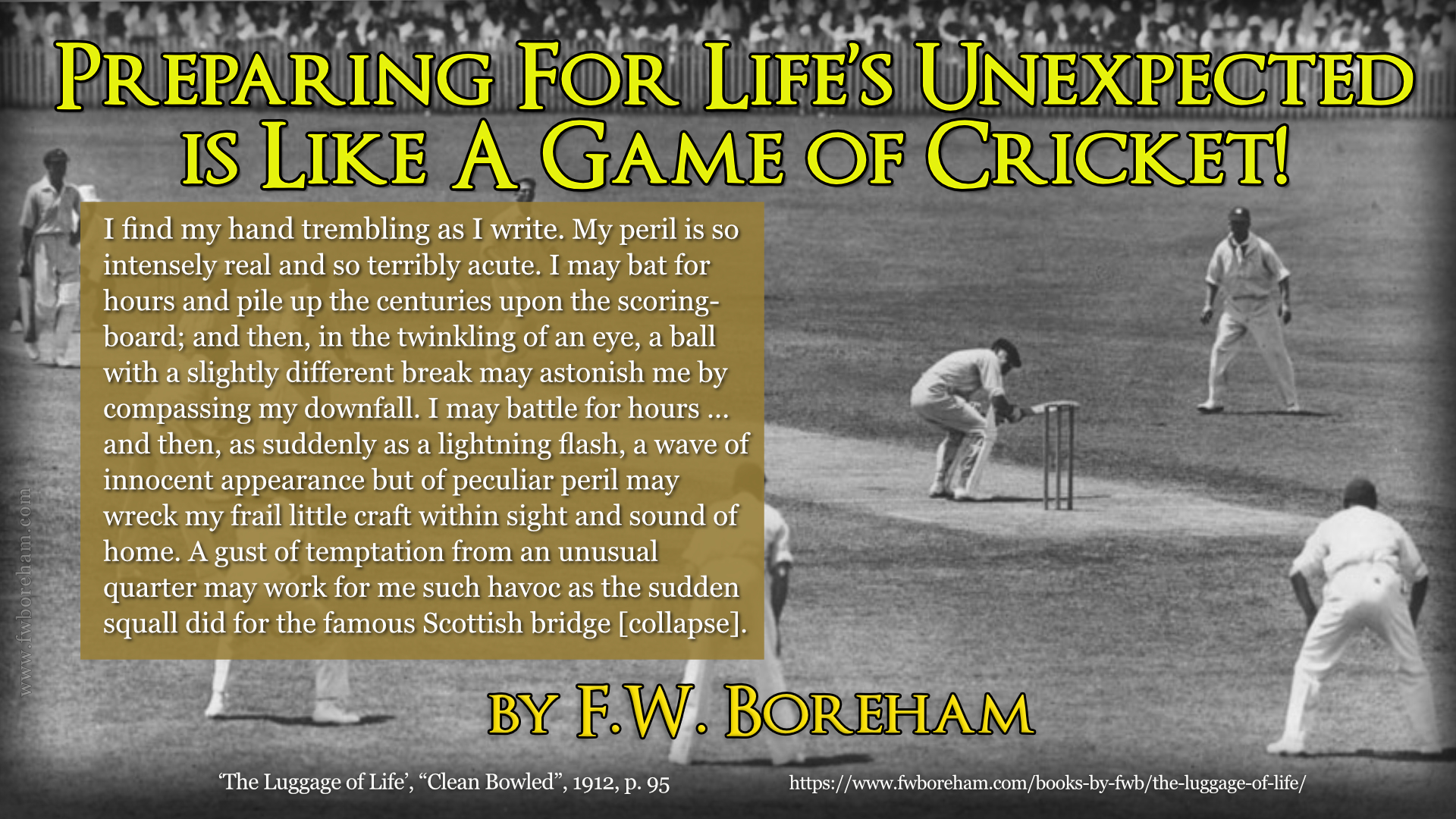
I find my hand trembling as I write. My peril is so intensely real and so terribly acute. I may bat for hours and pile up the centuries upon the scoringboard; and then, in the twinkling of an eye, a ball with a slightly different break may astonish me by compassing my downfall. I may battle for hours with the racing and foam-tipped breakers; and then, as suddenly as a lightning flash, a wave of innocent appearance but of peculiar peril may wreck my frail little craft within sight and sound of home. A gust of temptation from an unusual quarter may work for me such havoc as the sudden squall did for the famous Scottish bridge. Wherefore, says Mr. Stewart E. White, ‘Remember this: be just as careful with the very last wave as you were with the others. Get inside before you draw that deep breath of relief.’ And a still greater and even more experienced traveller adds: ‘Let him that thinketh he standeth take heed lest he fall.’ The logic of the flying bails is irresistible. And it is so woefully easy to be caught in the slips.
F. W. Boreham




![Navigating Strange Seas, Part 1, "ENGLAND" - Available to watch online as a rental or to buy digitally or as a DVD [more]](https://fwboreham.com/wp-content/uploads/2019/01/fwb-digital-download-part01.png "Navigating Strange Seas, Part 1, \"ENGLAND\"")
![NAVIGATING STRANGE SEAS, Part 2 - "NEW ZEALAND" - Available to watch online as a rental or to buy digitally or as a DVD [more]](https://fwboreham.com/wp-content/uploads/2019/01/fwb-digital-download-part02.png "NAVIGATING STRANGE SEAS, Part 2 - \"NEW ZEALAND\" - Available to watch online as a rental or to buy digitally or as a DVD [more]")
![NAVIGATING STRANGE SEAS, Part 3 - "HOBART" - Available to watch online as a rental or to buy digitally or as a DVD [more]](https://fwboreham.com/wp-content/uploads/2019/01/fwb-digital-download-part03.png "NAVIGATING STRANGE SEAS, Part 3 - \"HOBART\" - Available to watch online as a rental or to buy digitally or as a DVD [more]")
![NAVIGATING STRANGE SEAS, Part 4 - "MELBOURNE" - Available to watch online as a rental or to buy digitally or as a DVD [more]](https://fwboreham.com/wp-content/uploads/2019/01/fwb-digital-download-part04.png)
0 Comments