
Chapter 4
THE LAMPOON
IN one of her Australian stories, written many years ago, Miss Ethel Turner tells of a little lassie, the daughter of a Colonial statesman, whose duty it was to run to the door and take in the newspapers. With childish curiosity, she scanned the pages, only to be tormented by the ugliest representations, in the form of cartoons and caricatures, of her revered parent. At last, her indignation reaching its climax, she took a photograph from the mantelpiece and set off in charming wrath to show the offending pressmen what her father did actually look like.
The engaging story raises an interesting question. What is the relationship between a portrait and a caricature? Is a portrait something more than a caricature or something less? It is something less. A portrait may be a severely accurate representation of the man as he appeared at a given moment. A caricature, on the other hand, is not concerned with strict facial or personal resemblance. A statue based on a caricature would be condemned as a monstrosity. Yet, by wantonly exaggerating all the oddities, idiosyncrasies and mannerisms of the man, the cartoonist conveys an impression cd his vivid and palpitating peculiarities such as no sober portrait, or series of portraits, could possibly give.
A caricaturist makes it his business to exalt the impishness of exaggeration into real artistry. Nobody who saw Gladstone, in or out of Parliament, noticed anything unusual about his collars. Indeed, when the authorities of Madame Tussaud’s added Gladstone to their famous collection of waxworks, they sent to the statesman’s home at Carlton House Terrace craving one of his collars and were astonished to find that its dimensions were quite normal. But the wits of Fleet Street got the impression that Gladstone’s collars were slightly conspicuous, and, week by week, they portrayed Mr. Gladstone’s moods and tempers by the crumpled, sedate or defiant condition of his enormous collars.
To take another example, Lord Randolph Churchill-Sir Winston’s father-was tail, well-groomed,-with large, bright challenging eyes and a neatly curled moustache. But J. P. O’Connor pointed out that there was something about his behaviour in the House that reminded one of an eager, impudent, self-assertive schoolboy. Thereupon, Sir John Tenniel seized upon the idea, and, for years, Lord Randolph adorned the cartoons as a small and impertinent youngster. The caricature did a certain amount of violence to Lord Randolph’s stately stature; but, on the other hand, every sketch was such a lifelike presentment of the waggishness, unexpectedness and audacity of the statesman’s mind that it was felt to be a brilliant forthsetting of the real man.
One of the cleverest caricaturists of all time was Charles Dickens. Nobody knew better than he how to exaggerate the freaks and oddities of living men in building the characters that he wove into his fiction. John Leech, the great Punch cartoonist, used to rule his household with his deft and clever pencil. If there was any pouting or sulking or bickering, he would instantly draw a notebook from his pocket, and, with rare cunning, sketch the face that was flushed or puckered. A spice of mischievous exaggeration entered, of course, into the drawing; but, on its presentation to the youthful offender, smiles and merriment, not untinged with shame, invariably usurped the place of passion and tears. The principle is capable of infinite extension.
We should all be the better for seeing ourselves as others see us. Jesus Himself, the supreme master of every gracious art, displayed a rare skill in making men see the absurdity of their prejudices and frailties. Many a man must have gone home, after listening to those utterances by the roadside and the hillside and the lake-side to laugh at himself with a laughter that led him halfway to repentance. In poetic flight or telling parable, such a man looks into his own face as in a mirror and, seeing himself for the man he really is, highly resolves that, in the days to come, a nobler and a better being shall take that man’s place.
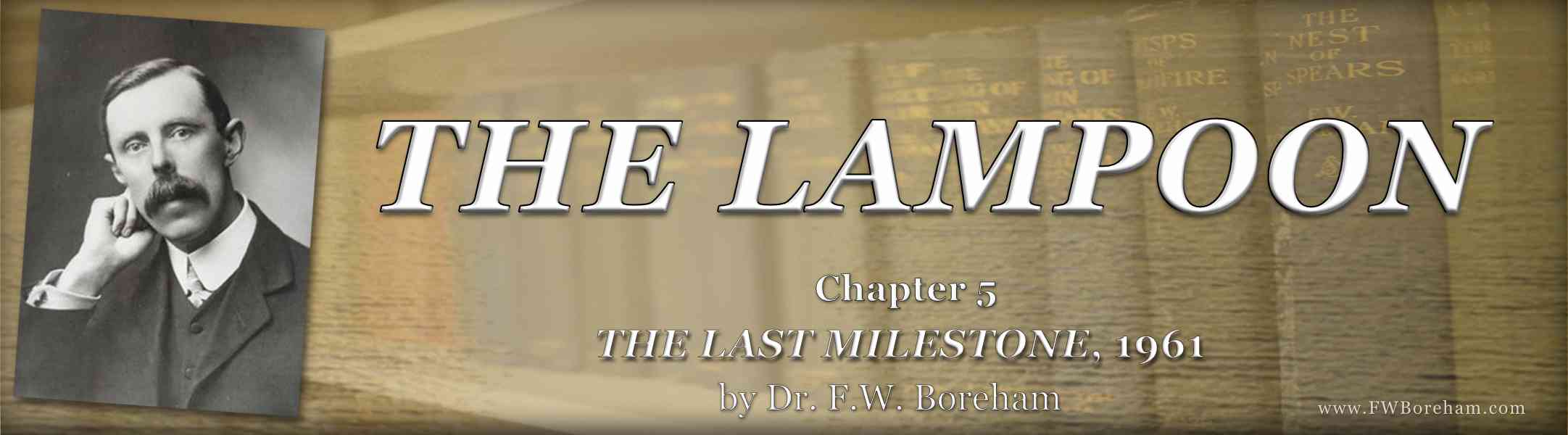
Dr. F. W. Boreham

![Navigating Strange Seas, Part 1, "ENGLAND" - Available to watch online as a rental or to buy digitally or as a DVD [more]](https://fwboreham.com/wp-content/uploads/2019/01/fwb-digital-download-part01.png "Navigating Strange Seas, Part 1, \"ENGLAND\"")
![NAVIGATING STRANGE SEAS, Part 2 - "NEW ZEALAND" - Available to watch online as a rental or to buy digitally or as a DVD [more]](https://fwboreham.com/wp-content/uploads/2019/01/fwb-digital-download-part02.png "NAVIGATING STRANGE SEAS, Part 2 - \"NEW ZEALAND\" - Available to watch online as a rental or to buy digitally or as a DVD [more]")
![NAVIGATING STRANGE SEAS, Part 3 - "HOBART" - Available to watch online as a rental or to buy digitally or as a DVD [more]](https://fwboreham.com/wp-content/uploads/2019/01/fwb-digital-download-part03.png "NAVIGATING STRANGE SEAS, Part 3 - \"HOBART\" - Available to watch online as a rental or to buy digitally or as a DVD [more]")
![NAVIGATING STRANGE SEAS, Part 4 - "MELBOURNE" - Available to watch online as a rental or to buy digitally or as a DVD [more]](https://fwboreham.com/wp-content/uploads/2019/01/fwb-digital-download-part04.png)
0 Comments