
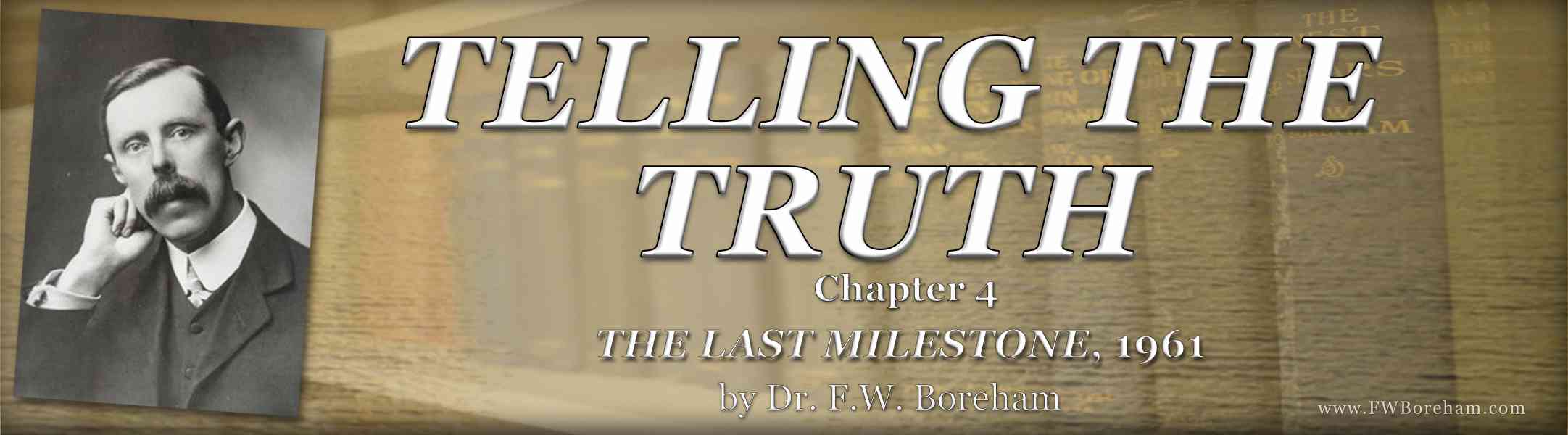
home > books by FWB > 1961 The Last Milestone > Chapter 4, TELLING THE TRUTH
Chapter 4
TELLING THE TRUTH
NYBODY who feels in the mood to bisect humanity will find that it consists of two almost equal parts. There are the Idealists and there are the Realists. When the Realists get together, as they often do, they solemnly admonish one another to ignore the utterances of the Idealists; it is all too good to be true; the Idealist walks with his head in the clouds. When, on the other hand, the Idealists foregather, as they often do, they agree to waste no time on the work of the Realists; it is all too true to be good; the Realist walks so closely with the actual and the factual that he has lost his appetite for romance.
Gradually, however, the Idealists have come to recognize that there is more poetry in reality than they had supposed. Once upon a time our painters confined their attention to gorgeous sunsets, panoramic landscapes, laughing-eyed children and lovely women. They told us. that is to say, that beautiful things are beautiful, a fact that we more than half suspected. Then, almost simultaneously, two babies were born, John Constable and Joseph Turner, who took it into their heads to prove that lots of things are exquisitely beautiful whose beauty had been cunningly camouflaged.
Constable led in the new age. ‘Give me,’ he cried, ‘leafless willows, old rotten planks, slimy posts and crumbling brick-work; I love such things and want to paint them!’ The pontiffs protested that such work was too true to be good; but, loyal to his conviction, Constable insisted on seeing the world through his own eyes and on depicting it as he himself beheld it. Whilst these feathers were flying, Turner was demonstrating that beauty is to be found, not only on the gleaming summit of the Matterhorn, in the blue water!: of the Bay of Naples and among the canals of Venice, but in the smoke-enfolded shipping of the murky Thames, in a battered hulk being towed to her last moorings and in a railway train rushing through the rain.
Surveying the inspired masterpieces of Constable and Turner, men felt that, if beauty lurked in such things, it might be found in any one of a million places in which it had never occurred to them to look for it. It just shows, as Richard Jefferies, the eminent naturalist, said at the time, that, if a man carries a sense of beauty in his eye, he will see beauty in every daily ditch he passes.
Charles Dickens was a boy when Constable and Turner were at the height of their great renown. He ached to write, but did not feel competent to write, as it was fashionable to do, of remote periods and distant scenes. But why not write of life as he himself knew it? He set to work and soon threw a lustre about rags and tatters. As da Vinci built up his superb mosaic from the scraps that his master had disdainfully tossed aside, so Dickens wove a most entrancing web out of phases of human experience that few writers would have deigned to touch. Truth, in any setting, has a Grace of its own. Nothing can be too true to be good. The world that a man sees with his own eyes is the only world that he is qualified to commit to glowing canvas, to rapturous stanzas or to sturdy prose. It is distinctively his world, and, in it, he is monarch of all he surveys. It is the bounded duty of every man charged with the onerous responsibility of expressing his soul for the public good, whether in art, literature, politics or religion, to convey a faithful articulation of his own vision.
Each sees as nobody else sees. Within the framework of his craftsmanship he must therefore express himself as nobody else can possibly do. First and last, he must be himself; must see things as he alone can, and then describe what he witnesses in the palpitating terminology of his own personality. As Rudyard Kipling would say, he must paint the thing as he sees it for the God of things as they are. And, expressing his naked and diaphanous soul by means of his palette, his pulpit, his platform or his Den, he will find, sooner or later, real truth, like wisdom, is justified of all her children.
Dr. F. W. Boreham

![Navigating Strange Seas, Part 1, "ENGLAND" - Available to watch online as a rental or to buy digitally or as a DVD [more]](https://fwboreham.com/wp-content/uploads/2019/01/fwb-digital-download-part01.png "Navigating Strange Seas, Part 1, \"ENGLAND\"")
![NAVIGATING STRANGE SEAS, Part 2 - "NEW ZEALAND" - Available to watch online as a rental or to buy digitally or as a DVD [more]](https://fwboreham.com/wp-content/uploads/2019/01/fwb-digital-download-part02.png "NAVIGATING STRANGE SEAS, Part 2 - \"NEW ZEALAND\" - Available to watch online as a rental or to buy digitally or as a DVD [more]")
![NAVIGATING STRANGE SEAS, Part 3 - "HOBART" - Available to watch online as a rental or to buy digitally or as a DVD [more]](https://fwboreham.com/wp-content/uploads/2019/01/fwb-digital-download-part03.png "NAVIGATING STRANGE SEAS, Part 3 - \"HOBART\" - Available to watch online as a rental or to buy digitally or as a DVD [more]")
![NAVIGATING STRANGE SEAS, Part 4 - "MELBOURNE" - Available to watch online as a rental or to buy digitally or as a DVD [more]](https://fwboreham.com/wp-content/uploads/2019/01/fwb-digital-download-part04.png)
0 Comments