
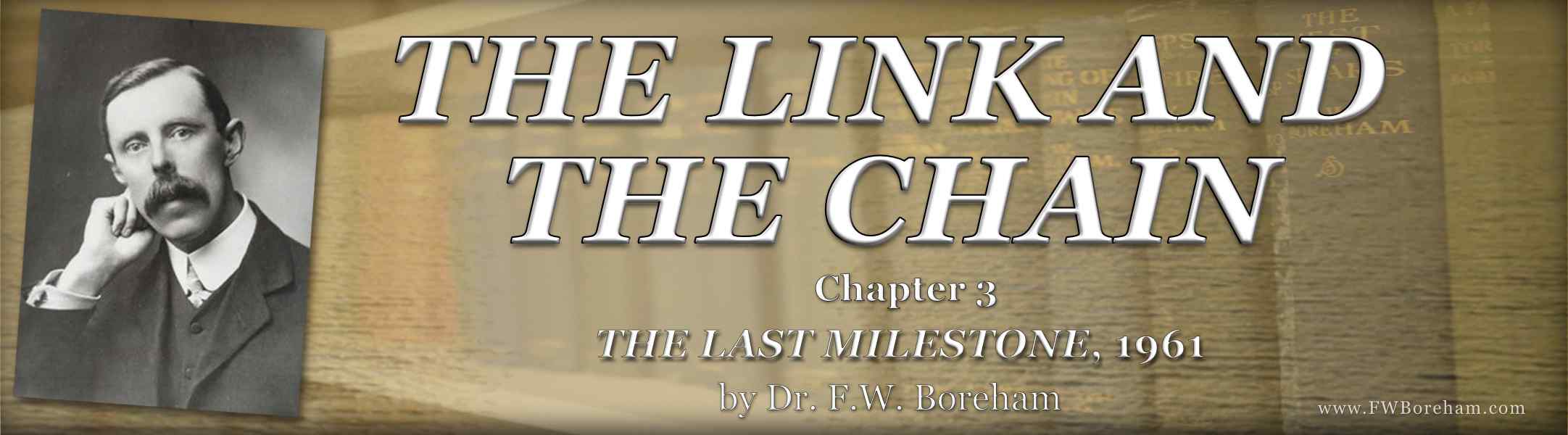
Chapter 3
THE LINK AND THE CHAIN
FEW laws are more familiar than the law by which the entity of the tree is lost in the immensity of the forest. Statesmen, and other leaders of public life, are confronted by the problem every day. In appealing for a concerted effort, it is the easiest thing in the world to lay your case convincingly before one man; it is the hardest thing in the world to appeal effectively to that same man when you meet him as one in a million.
A public speaker fancies that he has achieved the height of his ambition when, by the spell of his oratory, he is able to attract the crowd. As a matter of fact, it is at this very point that his trouble begins. For a crowd is an embarrassment unless you know how to analyse and dissect it. A lawyer cannot deal with clients in crowds; a doctor cannot deal with patients in crowds; and, faced by a crowd, a speaker is just as helpless. The crowd can applaud and cheer and display many forms of mass hysteria; but it is only to the extent to which the orator has convinced and influenced each individual constituting that crowd that any effective result has been achieved.
A crowd has no conscience to be stirred, no heart to be broken, no soul to be saved. The man who stands before a crowd can only hope to succeed so far as he knows how to disentangle the individual from the multitude. Like the stockman who, riding into a mob of cattle, swiftly and cleverly separates from its fellows the animal that he requires, the man who deals with crowds must acquire the secret of segregating the individual. A public speaker likes to see a singing sea of faces, just as an angler likes to feel that his line is surrounded by a perfect shoal of fish; it enhances his chance of catching, in quick succession, first one fish snd then another; but that is as far as it goes. To an orator, the crowd is simply the multiplied opportunity of individual conquest.
The task is a supremely difficult one. Lost in a crowd, the individual is as elusive as the pimpernel. We recall Oliver Wendell Holmes’s famous story of the attempt to make the inhabitants of the earth audible to the dwellers on the moon. It was thought that if the entire population of this planet shouted in perfect unison, the moonmen would probably hear and reply. For a year the most elaborate organization was brought into being to secure the precise synchronization of earth’s countless voices. But, when the fateful moment arrived, each individual was so anxious to hear the volume of sound emitted by the screaming millions that the appointed period proved to be a spasm of such tense silence as the world had never before known. The element of communal consciousness had entirely eliminated all sense of personal responsibility.
The problem invades even the loftiest realms. The two tiny patients, in Tennyson’s ‘Children’s Hospital’, urged to pray, could not understand how heaven, with so much to see to, could be concerned about the heartbreak of waifs like themselves. And John Ridd, the redoubtable hero of Lorna Doone, confronted a similar perplexity. With his love-affairs hopelessly entangled, he strode along those picturesque Devonshire lanes reflecting on something that he had heard about a Kindly Light that led amidst the encircling gloom of such confusions. ‘And at once, the stars shone out; but,’ he says, ‘they shed no light on my dilemma, but only set me wondering how He who leads those heavenly hosts, marshalling them in perfect order and rhythmic harmony, could find time for a pump fool like me’. We have all been afflicted, at some time or other, with such suspicions.
The children in Tennyson’s hospital and the distracted lover in Blackmore’s leafy lane failed to recognize the essential difference between immensity and infinity. The former has limits, the latter has none. If the Creator of the Universe is not only immense but infinite, then no stick or stone in the solar system can lie beyond his cognisance, no sparrow can fall to the ground without his notice. George Macdonald used to say that, unless the very hairs of one’s head are numbered, there is no God. It is vital, especially in these days, that all men should feel that, on the highest plane, the individual is never lost in the crowd; the forest is never allowed to obscure the trees.
Dr. F. W. Boreham

![Navigating Strange Seas, Part 1, "ENGLAND" - Available to watch online as a rental or to buy digitally or as a DVD [more]](https://fwboreham.com/wp-content/uploads/2019/01/fwb-digital-download-part01.png "Navigating Strange Seas, Part 1, \"ENGLAND\"")
![NAVIGATING STRANGE SEAS, Part 2 - "NEW ZEALAND" - Available to watch online as a rental or to buy digitally or as a DVD [more]](https://fwboreham.com/wp-content/uploads/2019/01/fwb-digital-download-part02.png "NAVIGATING STRANGE SEAS, Part 2 - \"NEW ZEALAND\" - Available to watch online as a rental or to buy digitally or as a DVD [more]")
![NAVIGATING STRANGE SEAS, Part 3 - "HOBART" - Available to watch online as a rental or to buy digitally or as a DVD [more]](https://fwboreham.com/wp-content/uploads/2019/01/fwb-digital-download-part03.png "NAVIGATING STRANGE SEAS, Part 3 - \"HOBART\" - Available to watch online as a rental or to buy digitally or as a DVD [more]")
![NAVIGATING STRANGE SEAS, Part 4 - "MELBOURNE" - Available to watch online as a rental or to buy digitally or as a DVD [more]](https://fwboreham.com/wp-content/uploads/2019/01/fwb-digital-download-part04.png)
0 Comments