
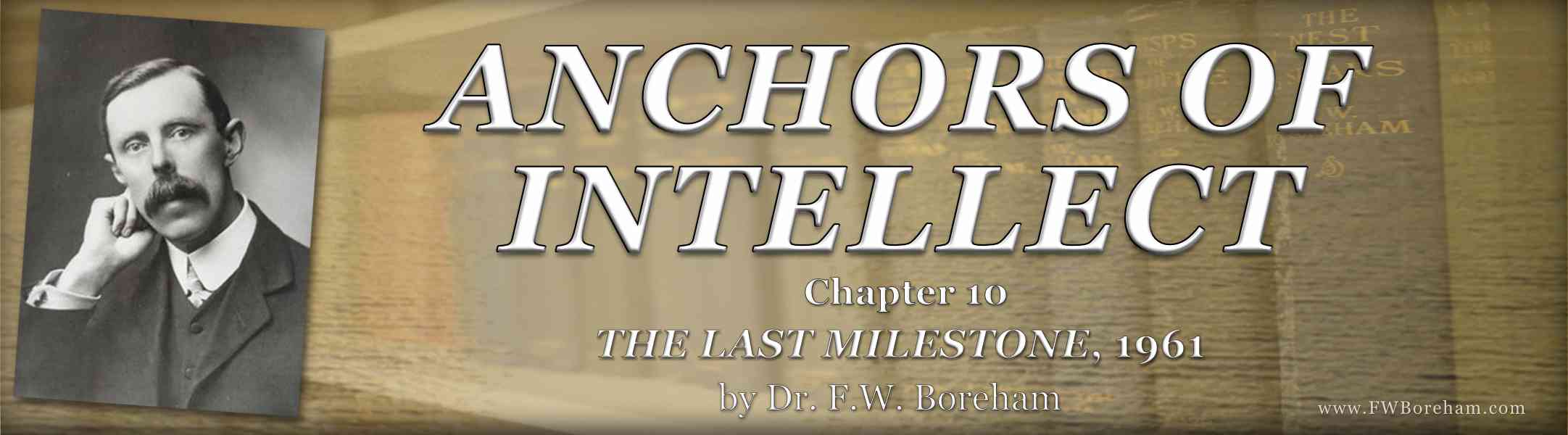
home > books by FWB > 1961, The Last Milestone > Chapter 10, ANCHORS OF INTELLECT
Chapter 10
ANCHORS OF INTELLECT
IT was said of Wordsworth that his music transcended in sublimity, profundity, and sweetness that of any of his classical contemporaries because he kept in his secret cupboard a modest stock of certainties. The phrase is provocative. In a world like this, no man can hope to wield a commanding influence in education or in politics, in Church or in State, or even among the affairs of the office and the home unless, together with a miscellaneous assortment of nebulous speculations and tentative opinions, he possesses a small but valuable hoard of inflexible convictions. We all detest and abhor the man who is cocksure about everything, but at the same time we pity the man who is certain of nothing. His path is shrouded in a perpetual haze, a fog that the sunshine never penetrates, a mist that drifts this way and that way, but never dissolves.
Those who have followed the adventures of George Fielding in It’s Never Too Late to Mend will remember how Charles Reade describes the search for the lost cattle. George takes Jacky, the blackfellow, and they set out on this quest under a broiling Australian sun. Presently Jacky makes an abrupt and cryptic announcement. ‘Jacky think!’ he says; and Stands stock still, intently surveying the horizon. A few minutes later he again breaks the silence. ‘Jacky know!’ he cries. He afterwards explains that, before the first ejaculation, he had seen a crow swoop down behind a distant hill. It aroused a suspicion. But when, on watching, he saw other crows coming from all points of the compass and converging on the same spot, suspicion crystallized into certainty. He knew. The two men tramped the six miles to the hillside, and there, surely enough, were the cattle. Few changes are more notable than the transition from the realm of ‘I think!’ to the realm of ‘I know!’
W. E. Henley, the poet who wrote ‘Invictus’ and who enjoyed the intimate friendship of Robert Louis Stevenson, said of Lord Lister, after the great surgeon had operated upon him, that ‘his rare, wise smile was sweet with certainties’. It is a noble and revealing phrase. The man who walks the street with a serene assurance, and who radiates among his patients or constituents, his customers or his colleagues, an infectious confidence is panoplied against the assaults of all conceivable and inconceivable eventualities. Every man should enjoy golden moments in which he leaves the chilly lowlands of doubt and plants his feet securely on the sunlit heights above. Life holds few more exultant or triumphant experiences.
Carlyle never forgot the moment at which he made that notable ascent. It was, he says, on a sultry dog-day in Paris. His spirit was clogged with inexplicable dread. He stopped, took hold on himself, faced the issues, and shook himself free from the frigid sensations that had oppressed him. ‘It was from that hour,’ he says, ‘that I date my spiritual rebirth; perhaps I directly thereupon began to be a man!’ His feet were on a rock. To the end of his days, he could never define the mental processes by which he attained this inward satisfaction.
In point of fact, certainty seldom comes by way of argument, proof, and demonstration. A man can prove along these lines that the three angles of a triangle are equal to two right angles or that two and two make four. But he cannot prove that the sun will rise tomorrow morning, that his mother loved him, or that his wife is true to him. It is only the minor things that are demonstrable; the major things scorn to submit themselves to that ordeal.
No man needs to be sure of everything. The captain of a ship, in bringing his vessel into port through a haze or a drizzle, does not need to see all the trees and the houses along the shore; if he can distinctly make out one or two fixed landmarks he can proceed with confidence. As in the case of Wordsworth, a very frugal stock of certainties will suffice to irradiate life. The charm of Paul’s epistles lies in the fact that, whilst he confesses to doubt and uncertainty on many subsidiary matters, there are a few stately verities on which he is able to speak with unwavering conviction. ‘I know whom I have believed; I know that nothing can separate me from the love of Christ; I know that all things work together for good,’ and so on. A man may be very hazy concerning a multitude of most important things, but if, like Wordsworth, he has in his secret cupboard a modest stock of such certainties as these, he can eke out a very comfortable existence here and greet the unseen with a cheer.
Dr. F. W. Boreham




![Navigating Strange Seas, Part 1, "ENGLAND" - Available to watch online as a rental or to buy digitally or as a DVD [more]](https://fwboreham.com/wp-content/uploads/2019/01/fwb-digital-download-part01.png "Navigating Strange Seas, Part 1, \"ENGLAND\"")
![NAVIGATING STRANGE SEAS, Part 2 - "NEW ZEALAND" - Available to watch online as a rental or to buy digitally or as a DVD [more]](https://fwboreham.com/wp-content/uploads/2019/01/fwb-digital-download-part02.png "NAVIGATING STRANGE SEAS, Part 2 - \"NEW ZEALAND\" - Available to watch online as a rental or to buy digitally or as a DVD [more]")
![NAVIGATING STRANGE SEAS, Part 3 - "HOBART" - Available to watch online as a rental or to buy digitally or as a DVD [more]](https://fwboreham.com/wp-content/uploads/2019/01/fwb-digital-download-part03.png "NAVIGATING STRANGE SEAS, Part 3 - \"HOBART\" - Available to watch online as a rental or to buy digitally or as a DVD [more]")
![NAVIGATING STRANGE SEAS, Part 4 - "MELBOURNE" - Available to watch online as a rental or to buy digitally or as a DVD [more]](https://fwboreham.com/wp-content/uploads/2019/01/fwb-digital-download-part04.png)
0 Comments