
IV
THE GREEN CHAIR
I
The green chair was never occupied. It stood—according to Irving Bacheller—in the home of Michael Hacket; and Michael Hacket is the most lovable schoolmaster in American literature. Michael Hacket possessed a violin and a microscope. The romps that he led with the one, and the researches that he conducted with the other, represented the two sides of his character; for he was the jolliest soul in all that countryside, and the wisest. But, in addition to the violin and the microscope, Michael Hacket possessed a green chair; and the green chair was even more valuable, as a revelation of the schoolmaster’s character, than either the microscope or the violin. Barton Baynes, the hero of the story, went as a boarder to Mr. Hacket’s school; and the green chair deeply impressed him.
When the family assembled at table, the green chair, always empty, was always there. Before he took his own seat, Mr. Hacket put his hand on the back of the green chair and exclaimed: ‘A merry heart to you, Michael Henry!’
It was a rollicking meal, that first meal at which Barton was present; the schoolmaster was full of quips and jests; and his clever sallies kept everybody bubbling with laughter. Then, when all had finished, he rose and took the green chair from the table, exclaiming:
‘Michael Henry, God bless you!’
‘I wondered at the meaning of this,’ says Barton, ‘but I dared not ask.’ Shortly afterwards, however, he summed up courage to do so.
Mr. Hacket had gone out.
‘I’ve been all day in the study,’ the schoolmaster had said; ‘I must take a walk or I shall get an exalted abdomen. One is badly beaten in the race of life when his abdomen gets ahead of his toes. Children, keep Barton happy till I come back, and mind you, don’t forget the good fellow in the green chair!’
He had not been long gone when the children differed as to the game that they should play. A dispute was threatening.
‘Don’t forget Michael Henry!’ said Mrs. Hacket, reprovingly.
‘Who is Michael Henry?’ asked Barton.
‘Sure,’ replied Mrs. Hacket, ‘he’s the child that has never been born.
He was to be the biggest and noblest of them all—kind and helpful and cheery-hearted and beloved of God above all the others. We try to live up to him.’
‘He seemed to me,’ said Barton, ‘a very strange and wonderful creature—this invisible occupant of the green chair. Michael Henry was the spirit of their home, an ideal of which the empty chair was a constant reminder.’
When a conversation threatened to become too heated, it was always Michael Henry whose ears must not be offended by harsh and angry tones; it was Michael Henry who had begged that a culprit might be forgiven just this once: it was Michael Henry who was always suggesting little acts of courtesy and kindness.
‘I like to think of Michael Henry,’ the schoolmaster would say. ‘His food is good thoughts and his wine is laughter. I had a long talk with Michael Henry last night when you were all abed. His face was a chunk of merriment. Oh, what a limb he is! I wish I could tell you all the good things he said!’
But he couldn’t; and we all know why. There was no Michael Henry! And yet Michael Henry—the occupant of the green chair—pervaded like a perfume and ruled like a prince the gentle schoolmaster’s delightful home!
II
We are very largely ruled by empty chairs. In support of this contention let me call two or three witnesses. The first is Clarence Shadbrook. Clarence was well on in life when I first met him. He struck me as being reserved, taciturn, unsociable. It took me several years, I grieve to say, to understand him. It was on the occasion of his wife’s death that I first caught glimpses of unsuspected depths of tenderness and sentiment within him. Hannah Shadbrook was one of our most excellent women. She had a kind thought for everybody. She was the heart and soul of our ladies’ organizations.
In every good cause her hand was promptly outstretched to help. She was especially tactful in her dealings with the young people: to many of the girls she was a second mother. She was tall and spare, with a slight stoop at the shoulders; her eyes were soft and gray; and her face was illumined by a look of wonderful intelligence and sweetness. She was the sort of woman to whom one could tell anything.
Somehow, I had always imagined that, at home, she was unappreciated. I cannot recall anything that I ever heard or saw that can have given me so false and unfortunate an impression. But there it was! And it was, therefore, with a shock of surprise that, at the time of her death, I found the strong and silent man so utterly broken and disconsolate.
‘Ah,’ he sobbed, when, in a few halting words, I referred to the affection in which his wife was held at the church, ‘I dare say. But it was at home that she was at her best. Nobody will ever know what she was to me and to the children who have married and gone.’
But it was not until two years later that he opened his heart more thoroughly. I heard on a certain Sunday evening that he was ill; and next day I made my way to the cottage. He was in bed. I stepped across to the window and laid my hand upon a chair, intending to transfer it to the bedside.
‘Excuse me,’ he said, ‘but don’t take that one. Would you mind having the chair over by the wardrobe instead?’
If the request struck me as strange, the thought only lingered for a moment. I replaced the chair that I was holding; took the one indicated; and dismissed the matter from my mind.
‘I dare say you are wondering why I asked you not to take the chair by the window,’ he said presently, after we had discussed the weather, the news, and his prospects of a speedy recovery. ‘There’s a story about that chair that I’ve never told to anybody, except to her’—glancing at a portrait—‘but if you’d like to hear it, I don’t mind telling you.’
‘Well,’ he went on, assured of my interest, ‘I took a fancy to that chair nearly fifty years ago. I was learning wood-carving; I thought that it would suit my purpose: and I bought it. It was the first piece of furniture that I ever possessed. I remember laughing to myself as I carried it to my little room. It stood beside the bed there for a year or two. Then I met Hannah. At first I felt a little bit afraid of her. She seemed far too good for me. But then, I thought to myself, she is far too good for anybody. And so our courtship began, and one night I came home tremendously excited. We were engaged! I lay awake for hours that night, sometimes painting wonderful pictures of the happy days to be, and sometimes lecturing myself as to the kind of man I must become in order to be worthy of the treasure about to be confided to my care. And I comforted myself with the reminder that I should have her always beside me to restrain the worst and encourage the best that was in me. And, thinking such thoughts, I at length fell asleep. But, sleeping, I went on dreaming. I thought that, coming home tired from the shop, I entered my little room at the top of the stairs (the room in which I was actually sleeping) and was surprised to find it occupied. A man was sitting in the chair beside the bed—the chair over there by the window. But I could not be angry, for he looked up and welcomed me with a smile that disarmed my suspicions and made me feel that all was well. I felt instantly and powerfully drawn to him. He seemed to magnetize me. His face realized my ideal of manly strength, tempered by an indefinable charm and courtesy. Then, as I gazed, it occurred to me that there was, about his countenance and bearing, something strangely familiar. What could it mean? Whom could it be? And then the truth flashed upon me. It was myself! Yes, it was myself as I should be in the years to come under Hannah’s gentle and gracious influence! It was myself transfigured! I awoke and found myself staring fixedly at the empty chair beside the bed—the chair that you were about to remove from the window there. I made up my mind that day that the chair should never be used. It is dedicated to the ideal self of whom I caught a glimpse in my boyish dream. And, even now, the shadowy visitor of that memorable night seems to be still sitting there; and I never approach the chair without mentally comparing myself with its silent occupant.’
Who would have supposed that, beneath the rugged exterior of Clarence Shadbrook, there dwelt so rich a vein of poetry and romance? I almost apologized to him for my earlier judgment. It only shows that, like the first Australian explorers, we may tread the gold beneath our feet without suspecting its existence.
III
My second witness is Harold Glendinning. Harold was the minister at Port Eyre, a little seaside town close to the harbour’s mouth. He had frequently asked me to exchange pulpits with him, and at last he had coaxed me to consent.
‘Come early on Saturday,’ he wrote, ‘so that we may have an hour or two together here before I have to leave.’
Like Clarence Shadbrook, Harold was a widower. But, unlike Clarence, he was still young. His wife had faded and died after three short years of married life. His mother kept house for him at the manse.
I reached Port Eyre early on the Saturday. We went for a walk round the rocky coast before dinner; and in the afternoon Harold made preparations for departure.
‘But, dear me,’ he exclaimed, ‘I haven’t shown you your room. Come with me!’ And he led me out into the hall and up the stairs.
The room was obviously his own. Photographs of his young wife were everywhere. Her presence pervaded it. The window commanded a noble view of the bay, and we stood for a minute or two admiring the prospect. We then turned towards the door.
‘Treat the place as though it belonged to you,’ he said. ‘Make yourself perfectly at home. You’re welcome to everything except—’ He half-closed the door again.
‘You’ll understand, I know,’ he went on, ‘but don’t use the armchair over there in the corner.’ I glanced in the direction indicated by his gaze. A comfortable chair stood beside a small occasional table on which a lovely bowl of roses had been placed.
‘It’s her chair,’ he explained. ‘It used to stand by the fireplace in the dining-room. She sat there every evening, reading or sewing, with her feet resting on her campstool.’ I noticed now that a folded campstool stood near the chair. ‘Somehow,’ he continued, ‘the chair seemed to become a part of her. And after—afterwards—I couldn’t bear to leave it there for anybody to occupy who happened to call; so I brought it up here. And, somehow, with the chair there, she doesn’t seem so very far away. I’ll show you something else,’ he said; and, diving into a drawer near his hand, he produced an old magazine.
‘I only found this afterwards,’ he explained. ‘At least I only noticed the marked passage. I saw it in her lap several times during the last week or two, and, in an off-hand way, I picked it up and glanced through it. But it was only after—afterwards—that I noticed that faint pencil-mark beside this poem.’ He handed me the magazine, and, surely enough, I detected a mark, so faint as to be scarcely visible, beside some lines by L. C. Jack.
When day is done and in the golden west
My soul from yours sinks slowly out of sight,
And you alone enjoy the warmth and light
That once had seemed of all God’s gifts the best;
When roses bloom and I not there to name,
When thrushes sing and I not there to hear,
When rippling laughter breaks upon your ear
And friends come flocking as of old they came;
I pray, dear heart, for sweet Remembrance sake
You pluck the rose and hear the songful thrush.
With laughter meet once more the merry jest
And great familiar faces still awake,
For I, asleep in the eternal Hush,
Would have you ever at your golden best.
‘You may think it strange,’ he concluded, as we turned to leave the room, ‘but I often fancy that the chair in the corner makes it a little more easy for me to live in the spirit of those lines.’
IV
I had intended calling several other witnesses; but I must be content with one. Alec Fraser was a little old Scotsman, who lived about seven miles out from Mosgiel. I heard one day that he was very ill, and I drove over to see him. His daughter answered the door, showed me in, and placed a chair for me beside the bed.
I noticed, on the other side of the bed, another chair. It stood directly facing the pillow, as if its occupant had been in earnest conversation with the patient.
‘Ah, Alec,’ I exclaimed, on greeting him, ‘so I’m not your first visitor!’
He looked up surprised, and, in explanation, I glanced at the telltale position of the chair.
‘Oh,’ he said, with a smile, ‘I’ll tell ye aboot the chair by-and-by; but how are the wife and the weans and the kirk?’
I found that he was far too ill, however, to be wearied by general conversation. I read to him the Shepherd’s Psalm; I led him to the Throne of Grace; and then I rose to go.
‘Aboot the chair,’ he said, as I took his hand, ‘it’s like this. Years ago I found I couldna pray. I fell asleep on my knees, and, even if I kept awake, my thochts were aye flittin’. One day, when I was sair worried aboot it, I spoke to Mr. Clair Mackenzie, the meenister at Broad Point. We hadna a meenister o’oor ain at Mosgiel then.
He was a guid auld man, was Mr. Mackenzie. And he telt me not to fash ma heed aboot kneeling down. “Jest sit ye down,” he said, “and pit a chair agen ye for the Lord, and talk to Him just as though He sat beside ye!” An’ I’ve been doin’ it ever since. So now ye know what the chair’s doin’, standing the way it is!’ I pressed his hand and left him. A week later his daughter drove up to the manse. I knew everything, or almost everything, as soon as I saw her face.
‘Father died in the night,’ she sobbed. ‘I had no idea that death was so near, and I had just gone to lie down for an hour or two. He seemed to be sleeping so comfortably. And, when I went back, he was gone! He didn’t seem to have moved since I saw him last, except that his hand was out on the chair. Do you understand?’
I understood.
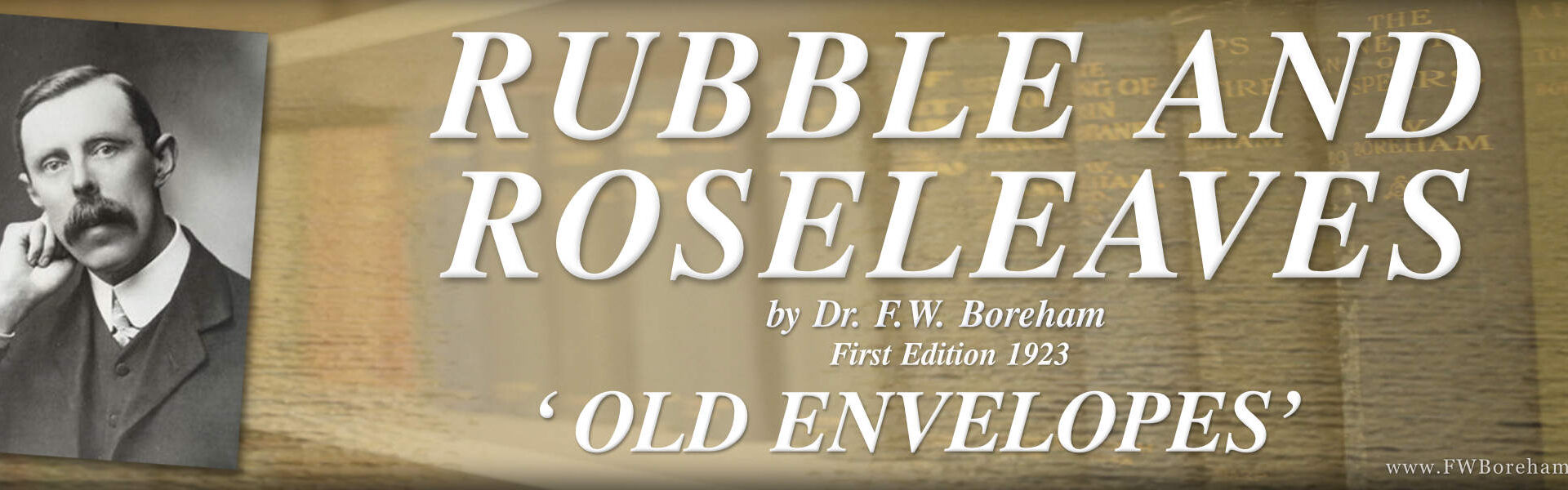
F. W. Boreham.




![Navigating Strange Seas, Part 1, "ENGLAND" - Available to watch online as a rental or to buy digitally or as a DVD [more]](https://fwboreham.com/wp-content/uploads/2019/01/fwb-digital-download-part01.png "Navigating Strange Seas, Part 1, \"ENGLAND\"")
![NAVIGATING STRANGE SEAS, Part 2 - "NEW ZEALAND" - Available to watch online as a rental or to buy digitally or as a DVD [more]](https://fwboreham.com/wp-content/uploads/2019/01/fwb-digital-download-part02.png "NAVIGATING STRANGE SEAS, Part 2 - \"NEW ZEALAND\" - Available to watch online as a rental or to buy digitally or as a DVD [more]")
![NAVIGATING STRANGE SEAS, Part 3 - "HOBART" - Available to watch online as a rental or to buy digitally or as a DVD [more]](https://fwboreham.com/wp-content/uploads/2019/01/fwb-digital-download-part03.png "NAVIGATING STRANGE SEAS, Part 3 - \"HOBART\" - Available to watch online as a rental or to buy digitally or as a DVD [more]")
![NAVIGATING STRANGE SEAS, Part 4 - "MELBOURNE" - Available to watch online as a rental or to buy digitally or as a DVD [more]](https://fwboreham.com/wp-content/uploads/2019/01/fwb-digital-download-part04.png)
0 Comments